Thursday, June 9, 2011

Day 3

  • What I did today 
 
Our second day of the trip started off with a beautiful sunrise, reflecting across the lake, making it my very first snapshot of the day... Not too long after, we jumped onto a duck. Not literally, though... It was an old WWII boat, that was remodelled and refurbished in order for it to look like a "duck-y" sort-of-thing. We went around town on a tour, learning about not only the historical significance of certain things, but also the cultural significances, too. Apparently, all of the houses in these areas cost millions of dollars, which I think is a lot of money! It was a lot of fun, especially travelling across two of the biggest lakes... I think it's pretty cool how each of the lakes has a name, like Blue Lake or Green Lake (no matter how cheesy they may be), and how they have a love story behind it! That's pretty neat. Quacking at all the people in town while we were driving was pretty funny, seeing as they would either wave nicely back at you, or just stare at you with a blank face... I started laughing every time the tour guide turned on "Mission Impossible" when we were about to enter the water from ground! It was very entertaining in my opinion! But, it was a little chilly in the morning. However, I didn't have that ruin my day.
Just right before we were going to go to our next stop, we stopped by a little cafe on the road to Auckland and got lunch... I got two mini pizzas (with ham, cheese, peppers, and onions with spaghetti and tomato sauce underneath... who knew you could do that!), chips (or fries), and L&P (which is a Sprite-y sort of drink with a lemon-y after-taste)... It was simply spectacular and delicious!!!
After everyone got refreshed and into new clothes, we boarded the bus and started heading to the Agrodome. I was excited! Ever since I heard we were going here, I had a picture in my head of what it would look like, smell, and feel... Turns out, I was nearly there! I got the smell part right, which was just like sheep or other cattle you would find on a farm, and then the feeling of it, which I thought I was on some farm... But I completely imagined it totally different! I thought it would be bigger, like a stadium, with a lot of people; but that's okay, I enjoyed it the way it was better! The person, who was the host of the show, was really 
funny! He made jokes about pretty much anything relative to what he was doing at the moment, or even 
interacting with the audience and the people, more 
specifically! It was a really interesting show, I have to say... It gave a little tid-bit on all things New Zealand, especially when it comes to agriculture, farmland, and animals! Looking back at today, I have to say it was one of the funniest shows I've ever seen! Even a sheep liked me...!

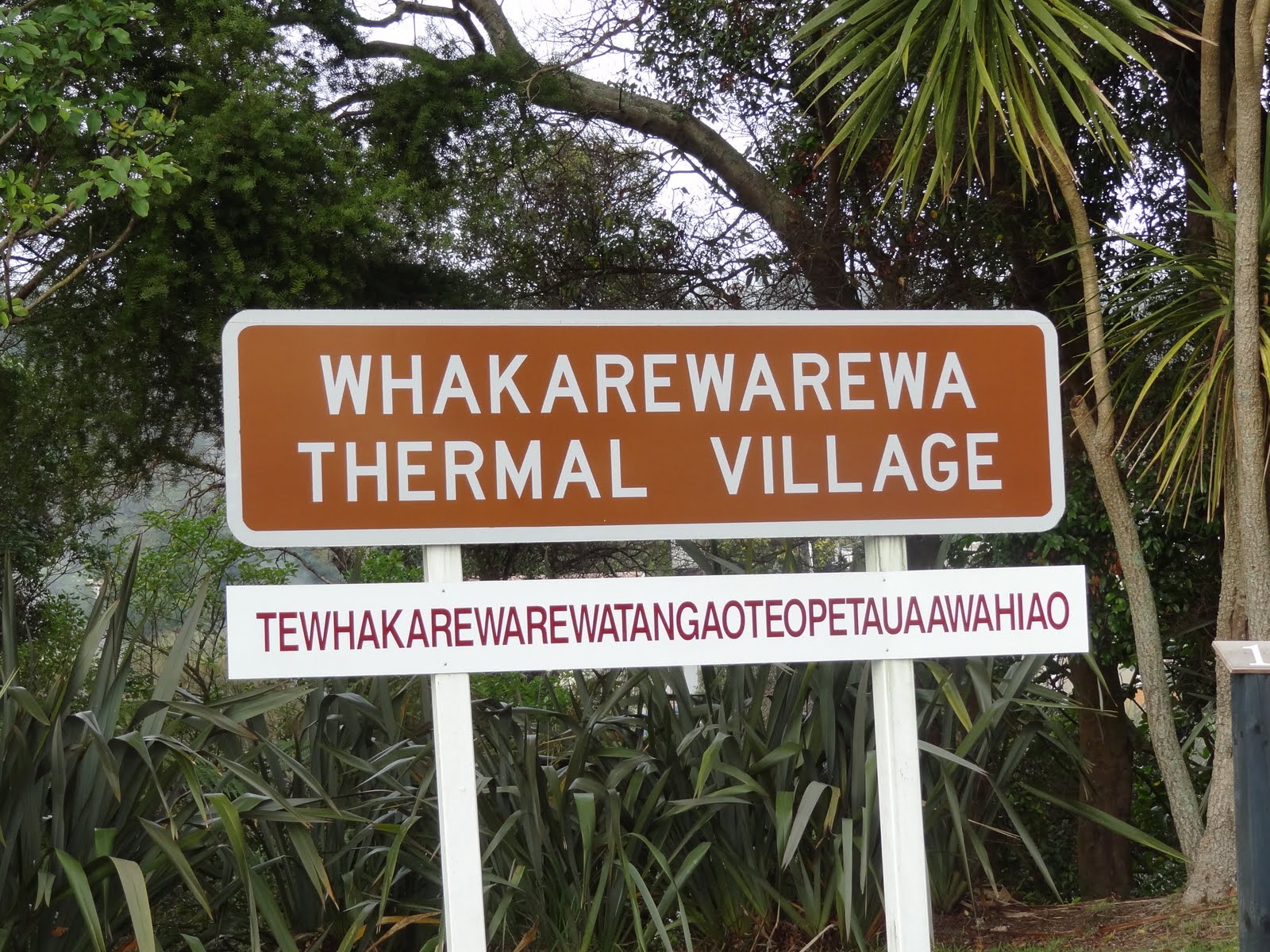
Before I knew it, we were heading to Whakarewarewa, or Whaka for short, a geothermal village where some of the Maori people live today. Here, we got an inside-look at the life of the Maori and their culture. I learned that they use geothermal energy for pretty much anything that needs to be heated up or cooked. In order to cook their food, for whichever meal it may be, they use these wooden boxes that are built upon a geyser, into which they put their aluminium foil wrapped foods in. After a couple of hours, the food is ready. Their heat inside their houses is also created using geyser energy... I learned so much about their village, including how and when they use the geothermal energy, and in which ways it is useful. Even legends and myths are created and have been to told to generations of Maori people using geysers and their eruptions! The geysers are so unique and cool when they erupt, which is said to be about every 10 minutes or so.
Every little part of the Whaka village has an importance to their culture, and I found this part of the day the most interesting and enjoyable! Having a Maori tour guide also helped in getting information across, because not only did I learn how to say a few Maori words, but I also now know the full version of the name of the village and how to pronounce it, which is Tewhakarewarewatangaoteopetauaawahiao... Quite long, isn't it? Surprisingly, a lot of the Maori words are long like this one, each one also having a shortened version. There's even a longer one! Going to Whakarewarewa was truly very inspiring and I learned a lot about the Maori culture, history, and lifestyle today!


    After visiting the geothermal village, we went zorbing. Another popular thing to do in New Zealand! It's pretty much when you roll down a big, bumpy hill in a big ball filled with warm water... It's veryyyyy fun to do, enough said! To end our magnificent day, we went back to the hotel and enjoyed yet another Maori show, consisting of songs and dances, as well as a delicious Hangi dinner and dessert, which the Maori prepared for us. The Maori people showcased their traditional Maori dances and songs, inviting us to join in with them. Later in the show, they let us have a chance on-stage, girls dancing with the poi and the boys learning the Haka. I was one of the many girls lucky enough to go on-stage and try dancing with the poi. I have to admit, it may seem realllllllly easy, but it's sooooo hard! Not only do you have to have your arms firm and only your wrists moving, but you have to keep the poi in various constant motions and positions, all while singing and dancing around... It's so hard, but so much fun!!! I like it! And then there were the boys doing the Haka for the first time... Actually, most of them were really good, I have to say! I couldn't stop laughing at Mr.Barry's, especially Mr.Schagrin's, warrior faces... Wide eyes, tongue out, determined face... Definitely a good mix!!! Once again, there are so many motions and positions you have to know by heart, it's kind of ridiculous, but also very fun! No doubt about that! These two dances are a big part of the Maori culture and greatly emphasised to people around the world, especially in New Zealand! The Hangi dinner was very delicious! Amongst a big mix of many east and west styles of food, I tried the most famous "Kiwi" dessert, Pavlova! It was so good, I wanted more! Today was a day full of surprises, fully enriched in culture and very eye-opening!


    • Journal of the Day 
    Today was a day full of many, many, many culture shocks! Taking the Duck Tour in the morning, sparked a couple culture shocks before going to the Whaka village. I saw these really cute ducks, one with a white head, which I thought was really unique, just like a culture... When we DID reach Whakarewarewa, I was so surprised about how much Maori culture is hidden behind it! Many of the ancestors' kids live here now, all trying to make people aware of the Maori culture and lifestyles, as well as history. Having the village set on a big geothermal patch of geysers, gives the village many upsides. They use natural, geothermal energy in order to heat up their homes and cook their food, during spring, summer, fall, and winter! No matter what the weather is like, they always use these wooden boxes to cook their food (covered in aluminium foil), which are set on top of geysers. These geysers have also created history to their culture! They even have mud baths and public baths that are used for the Maori people to clean in, as well as cure or heal certain injuries. It's believed that these mud pools can also help one  stop from aging quickly... this I thought was interesting! As I've learned today and discovered, a lot of Maori culture, history, language, foods, dances, songs, and many other things, have been preserved in this village for a long time, and are meant to be for another long period of time. Family is also an important part. I also got to see their homes and churches... We had an inside-look into their village! Going to Whakarewarewa, I realised that every person has a different styl e adn way of doing things. Every culture, every heritage, and every family has unique traditions in their culture that need to be preserved... these cultures separate people from people, showing their individuality and who they really are on the inside. Their beliefs and lifestyle characteristics also shine through. This is the biggest culture shock I learned and saw today! It truly showed a different side of the Maori people, especially than of what I knew before coming here...

      Wednesday, June 8, 2011

      Day 1-2


      • What I did today
      Guess what?!
      So the day has finally come...! Eep!

      After a lot of preparation, I'm packed, ready, and super excited for this trip!!! We've left Grayslake North at around 3:15, jumped on a bus to O'Hare Airport, and boarded our very first plane of the trip... Well, two, officially! Right after landing in L.A., we quickly boarded our next plane to Auckland. My very first loooooong plane ride! It was about 15 hours! I slept, and slept, and slept... I was soooo tired! Next thing I knew, we crossed the International Dateline and lost a day, so it's officially June 8th right now... Again. And in a wink of an eye, we landed in New Zealand!!! Who knew I'd be here right now?
      We finally landed in Auckland, New Zealand. New Zealand was nothing like I thought it would be... Right after going through customs and all the "busy" stuff, I stepped on New Zealand ground for the very first time. I was completely speechless! Even throughout the entire 3-hour bus ride! At that moment, I didn't care how long it was, it didn't even seem like it at all... I was completely captivated by the beauty of this country! The rolling green hills, the far-off dark mountains, the "green-ness" of everything... It was a complete different atmosphere than back home. There were a million cows and sheep everywhere I looked! It was absolutely stunning! No words could describe the beauty of the nature around us; even pictures didn't capture the entire moment! It was definitely a moment and scene I will always remember!

      After taking it all in, we stopped for lunch in a small, yet cute, little town called "Hobbiton" (Matamata). There was a small statue of a Gollum in the heart of the city, and once in a while, I would come across something closely relative to things in the Lord of the Rings, since this movie was filmed in New Zealand. For lunch, I had this kabob sort-of-thing with fried/cooked meat (I'm pretty sure it was lamb) and some chips (otherwise known as fries or wedges). My first "Kiwi" dish was simply delicious!

      Not too long after, we went luging... Yes, luging! It's pretty much where you ride full speed in a mini go-cart down a scenic trail full of sharp turns, twists, and drops, down a hillside... And once you were done, you would take a gondola back up to the top of the mountain. I went down twice, but it definitely wasn't enough! I kept screaming all the way down, because even though I felt like I was about crash the whole time (and only wearing a helmet), that didn't stop me! I always had a smile on my face!

      So, in order to go full speed on the go-cart, you had to push the handles forward to go forward, and pull them towards you in order to slow down or stop. Seems easy, right? Well, I got it pat-down very quickly... however, on my second time down, I was so excited, getting closer to the end, going at full speed, that I completely forgot what I was doing... I pulled the handles towards me right in a middle of the mountain! I was stuck. I didn't know what to do, so I started "scooting" my cart while trying to go forward, and before I knew it, there was a line of about 6 people behind me, all crashing into each other, all because of me!!! It was embarrassing, yet the funniest thing that has happened to me on the trip... After a long time of "scooting" and "tugging" my cart to go forward, I made it down the hill, stood up, and smiled! It's the least I could've done...
      Overall, I've never done something like this before in my life, and I definitely don't regret trying this in the first place...
      We also went to the Mountain Jade Factory, where we got a chance to learn about how Jade is made (after retrieving it from the mountains in New Zealand) into really pretty shapes, that can be used for necklaces earring, and other decorations. We also got a chance to buy some of them, too. It's not everyday you can buy Jade! I thought it was pretty interesting...
      After our long day so far, we finally reached Rotorua. The first thing that hit me, was the distinct smell of rotten eggs. It smelled absolutely horrible at first, but as the hours passed by, I quickly got used to it. After having dinner at Burger Fuel, which has the BEST burgers I've ever tasted, we went to Pak n' Save, which was a local grocery store located pretty much across the street from our hotel.
      As soon as I got back to the hotel, I was "out of it" and soooo tired. I can't wait until tomorrow!

      • Journal of the Day

      When we first arrived in Auckland, I didn't know WHAT to think... Yes, New Zealand was pretty much on the opposite end of the world for me and seeing it, as well as being there, I couldn't believe I was actually here! However, because of the main language and how people act, I really didn't feel like I was far, far away from home. Rather, I just felt as if I was in some far, far away place from home in Illinois. But, as soon as I began to see all of the differences in this country, such as the atmosphere, I began to really feel like I was in New Zealand! My first impressions included seeing the enormous amount of farmland and nature. There were so many hills, a lot of open space, and everything that was green, was even greener! It was nothing compared to America, since it's all pretty much gone and covered with buildings and houses. And when you need a quite, nature-like place to relax, it's really hard to find one. Here, it was a different story... I felt connected with the world for some time, and I thought that this also made a small impact on the people here, too. One culture shock that I experienced on my first day here, is the enormous amount of cows and sheep that was everywhere. I learned that for every person living here, there's about 14 sheep, totalling in about 40 million sheep country-wide, which I think is a lot! Even though New Zealand is greatly known for sheep, I saw quite a lot more cows than sheep, which I thought was a little weird for a second.
      Another culture shock that I experienced was that the people of New Zealand, often referred to "Kiwis", drive on the left side of the road, with the driver's seat also on the other side of the car. At first it didn't seem strange, but as we started crossing the streets and seeing the drivers on the other sides of the cars, it began to seem a little "out-of-place"... Finally, my third culture shock was the food and drinks. I expected them to carry similar brands of nutrition, or even make their food in a similar way, but I was wrong. They carried similar tastes in certain foods, like the L&P tasted like Sprite, but nothing close in name. And they even made their food differently, using different ingredients, like the mince pie, which was a pastry filled with a type of meat. This was definitely quite different, or at least I thought so. As this trip holds many more experiences and surprises, both in New Zealand and Australia, it's hard to say what I actually look forward to... Right now, while still in New Zealand, I can't wait until the Hangi dinner and meeting my Kiwi friends! It's going to be very exciting seeing a different aspects on culture, as well as learning about it and the country in general! One thing I can say, is that while I'm finally here, and STILL here, I will make the best of it!!!

      Tuesday, May 31, 2011

      Blog 10: Rabbit-Proof Fence

      Human rights have always been a problem in our world today and in history, taking place in different parts around the world, holding different situations, as well as taking place at different times... However, whoever was being affected never gave up to stand up for them, which makes our world so much stronger today!

      In "Rabbit-Proof Fence", Aboriginal populations face injustices as the European settlers begin to colonize the western coast of Australia. The entire Aboriginal population realized that the arrival of the European settlers meant "the destruction of their traditional society and the dispossession of their lands" (Pilkington 13). The Europeans were pushing the Aboriginals away from their lands, not noticing that they were taking everything away from them, especially going against their individual rights...

      While the Aboriginal population was being held in one area by the Europeans, the Nyungar people were cut off from their natural food source, hoping that maybe some of the white people would give them a portion of their food. However, Molly's uncle, Moody, explained and reminded the Nyungar peoplethat "when an old man Udja complained to the magistrate that a white man stole his wife, Nella, he was given a bag of flour and told to go home... That old man expected the same form of justice under the white man's law. He never got it" (Pilkington 15). This incident shows that the "Right to Equality Before the Law" and the "Freedom from Discrimination" was being violated. The Aboriginal population was being treated more strictly than the European settlers, even if it was their land. They had their food taken away, and when they wanted to get something back from  the white people, they couldn't; the Europeans thought that they were much more superior than the Aboriginals and could control them. This was probably happening because of the differences in race, but it shouldn't have if they were following the laws...


      Another incident happened when Bidgup and Meedo wanted to go down their hunting trails, in search of fresh food. They weren't allowed to go any farther than what they saw in front of them because the trails are all blocked by fences. Meedo explained that "when [they] climbed over the fence, one of those men pointed one of those things- guns- at [them] and threatened to shoot [them] if [they] went in there again" (Pilkington 14). The Aboriginal population, nevertheless the Nyungar people, weren't allowed to walk on their land, wherever they please. They were told to stay in one area, the area within the fences. Even though the two tribe members wanted to go hunting, they couldn't. This was clearly a violation of the "Right to Own Property" and the "Right to Free Movement...". The native tribe members weren't allowed to walk on their own soil, which was taken by the Europeans. It was a separation of land between the Aboriginals and the Europeans. Not only did they take all of the fertile land for themselves, but they left the Aboriginals with nothing, only that of what they gave them, which wasn't much. According the the law, this was not allowed, but the law was still broken...

      Finally, the Aboriginal culture was always being threatened. The native tribe remembers "the corroborrees and songs that they were forbidden to dance and sing" unless they were forced to do so by the government officials (Pilkington 16)."...The corroborrees [they] shared and danced by scores of feet" would be left in the dust surrounded by the moonlight of the open fire, "warriors with painted bodies and plumes of feathers on their... heads" would be lost, forgotten, and left in the past, and "important dates on their seasonal calendars" would be gone. Every little part of their culture was being taken away from them and always being limited to their growth, as well as what it could become. Their traditions and beliefs were always at the risk of disappearance. No matter how hard the Aboriginals tried to keep the characteristics of their culture and who they are intact, it was always being forced to change by the Europeans. They were always being torn apart from their population and culture, and this only showed the violation of the "Right to Participate in the Cultural Life of the Community", the "Freedom of Belief and Religion", and the "Right to a Nationality...". Maintaining their culture was always a struggle for them, all because the Europeans were always interfering with it...

      This, what had happened with Australia and its Aboriginals, mirrors many events and situations that have happened in the United States. In Australia, the European settlers thought that everything that they did was necessary and appropriate for the country's growth, thinking that they were "civilizing" it. However, they were doing quite the opposite; they were ruining the country, stopping it from evolving into something more, something that it could be in the future.

      The Manifest Destiny was the 19th century belief that the United States was destined to expand across the North American continent, from the Atlantic Seaboard to the Pacific Ocean. They thought they could change the country, more like the world. This same exact belief stretches back even farther into history, way back when Christopher Columbus "sailed the ocean blue", Spanish monarchs were taking over, and pilgrims were still trying to find their way... The Native Americans, much like the Aboriginals, were having everything taken away from them, their food, their culture, but most importantly, their land. They were treated like dirt, like they were nothing and didn't matter. However, they never gave up on their beliefs and their strength to keep moving forward, no matter how many rights they were being taken away. Those rights were exactly the same ones as the Aboriginals and many more; they weren't treated fairly compared to others, they were being moved out of their land, and their culture was always being questioned...
      Many events that happen in history mirror those of other events at other time periods, just like in Australia and in the United States.

      Every situation has its own purpose, and every situation has some solution. However, not every solution fits the the purpose of the situation... (As confusing as that may sound...)
      Let's take, for example, what had happened in Australia. Children were being taken away from their families, from their mothers, but why? Was it justified to do this? Some might defend that the actions of the government were morally justified, especially the relocating of children of mixed descent. However, I personally believe that this was wrong, in every way, shape, and form. Even though children may have been relocated for what was thought as "better", it wasn't at all. Children were being taken away from their mothers and families. At this point, it didn't matter what race or culture they were; all that mattered was the fact that they were being relocated. This wasn't justified at all, even by the government, or at least I think so... What do you think?

      Aboriginals in Australia and Native Americans in the United States are two very different but similar cultures and tribes, not only in traditions and beliefs, but most importantly, in what they went through in the past. They faced tough times, physically and emotionally. But, they never gave up! And that's how far the world has come today...
      If something is meaningful to a person, that person won't stop, rather keep going until they're satisfied with the outcome!

      Sunday, May 8, 2011

      Blog 9: Invasive Species

      Have you ever heard of a Cane Toad?
      Maybe yes, maybe no... Either way, I haven't... And you might not even know that it's an invasive species in Australia!

      Also known as the Giant Toad or the Marine Toad, the Cane Toad is very tough and adaptable, as well as poisonous throughout its life cycle, and only has a few predators in Australia, making it very invasive to the lands... Especially to the native amphibians of Australia.

      The Cane Toad is very large, heavily-built amphibian with very dry, warty skin. They have a bony head, as well as bony ridges that are right above their eyes and meet above their nose. Their hind feet have leathery webbing between the toes, while their front feet aren't webbed at all. They sit upright and move in short, rapid hops. Cane Toads appear in a couple of colors... They're usually gray, yellowish, olive-brown, or even reddish-brown, and their bellies are pale with dark specks, and their average size is about 15 cm...

      These interesting amphibians are usually found ranging from the southern part of North America to the tropics of South America. However, in the early 1930s, Cane Toads were introduced to Australia from Hawaii in order to control the pests of sugar canes, including beetles. Ever since then, the Cane Toads have been breeding and spreading drastically all over Australia, totaling in about 200 million, and are now considered a major invasive species to the lands.

      Cane Toads excrete poison, that is not only harmful and toxic to humans, but to the native animals as well. Other animal species that have not adapted to the presence of the Cane Toads don't have a chance to fight back when they're being attacked, and the Cane Toads' predators die off. These poisonous frogs are killing off many species on the continent, as soon enough, a numerous amount of species will be gone forever!
      Many scientists have been biologically affecting the breeding process of these toads, as well as notifying the public by using quarantine checks and awareness announcements in order to inform people of these dangerous, toxic toads.

      Cane Toads are a perfect example of an invasive species in Australia, just like the Citrus Long-horned Beetle is an invasive species here, in the United States...

      The Citrus Long-horned Beetle is native to Japan, China, and Korea, where it is considered a pest, among many others. Infestations by the beetle can kill many different types of hardwood trees, as well as citrus trees, pecan, apple, Australian pine, hibiscus, sycamore, willow, pear, mulberry, pigeon pea, Chinaberry, poplar, litchi, kumquat, Japanese red cedar, oak, and ficus.

      The Citrus Long-horned Beetle poses a threat to the environment in North America, mostly because it attacks healthy trees and has no natural enemies. Not only are greenbelts, urban landscapes and backyard trees at jeopardy, but also orchards, forests, and endangered salmon, and wildlife habitat. This invasive species was first spotted on bonsai trees that were imported from China in 1999 in Georgia. There were three female beetles spotted and captured that were ready to lay eggs, but after a while of research, eight larvae tunnels were found in the bonsai tree that were built as exit tunnels... That meant that five Citrus Long-Horned Beetles escaped into the surrounding community, leading to thousands more of beetles. This species has become a threat to the United States, but many scientists and people have been keeping them compact in one place.

      As you can see, not only are there invasive species here in the United Stated, but also in Australia, which can all lead to major types of harm in many different ways! We need to watch out for invasive species, because we never know where they're from or what they do to harm the community...
      In other words, invasive species are bad to the country!

      Sunday, May 1, 2011

      Blog 8: Exploring Oceans


       Video: http://www.youtube.com/watch?v=wbNeIn3vVKM

      1. The Great Barrier Reef is considered the "largest living structure on Earth".
      It's known for its incredible size and biodiversity in several species of animals. Many different types of coral are home to even more types of different animals... The Great Barrier Reef is amazing, from top to bottom!

      2. What compound does coral extract from the ocean to make solid tentacles?
      Calcium carbonate is extracted from the ocean, the compound that is used to make tentacles. These solid tentacles aid in feeding habits, in which a diet varies from small fish to plankton.


      3. How does red algae impact the structure of coral?
      Whenever you see pictures of the Great Barrier Reef, you usually see many clumps of various species of coral in one area. These corals are connected and usually grow in size all together. Acting like pink glue, red algae cements several fragments of coral to other coral, creating a humongous structure of different types of coral. If it weren't for red algae, species of coral would just be growing on its own in random spots of the ocean. With the help of this extraordinary red algae, the ocean looks beautiful with colorful coral every inch on the bottom of the ocean.

      4. What year did the Great Barrier Reef become a national park?
      The Great Barrier Reef became a national site, to be preserved, in 1975. Even though it became a national park, it doesn't necessarily mean it's protected from danger all the time. The environment and fishing are still hazards to the reef, that are trying to be eliminated, all in order to protect the diverse amount of species and life underwater.

      5. What percentage of the reef is protected from fishing?
      Out of the entire Great Barrier Reef, only 33% of the reef is currently protected from fishing. As you can see, this is a very small portion of water being protected in comparison to the entire Great Barrier Reef.

       
      6. How old do scientists believe the CURRENT reef is? The ANCIENT reef? 
      Studies have shown that there are two reefs on top of each other located in the Great Barrier Reef, the current one as well as the one buried underneath it. The current reef is thought to be 20,000 years old, and the ancient reef is thought to be about 1/2 million years old! 

      The Great Barrier Reef is astonishing in many, many ways... However, it's very old and fragile, and something like this must be protected from all danger in the world. Before you know it, it may disappear... and that could be either today, tomorrow, or in a couple of years. No one knows for sure, so we must act now!